
A rising traffic counter feels like progress. Then the inquiries don’t follow, and it becomes clear that visits and revenue aren’t the same thing. The gap between the two comes down to one word: intent. As a freelance digital marketing expert in Kochi, I’ve seen this play out again and again a handful of people who are genuinely searching for what you sell will outperform a flood of visitors who were never going to buy
This guide focuses on the part that’s easy to skip past finding the people who are already looking for you and building the follow-through that turns their interest into a sale.
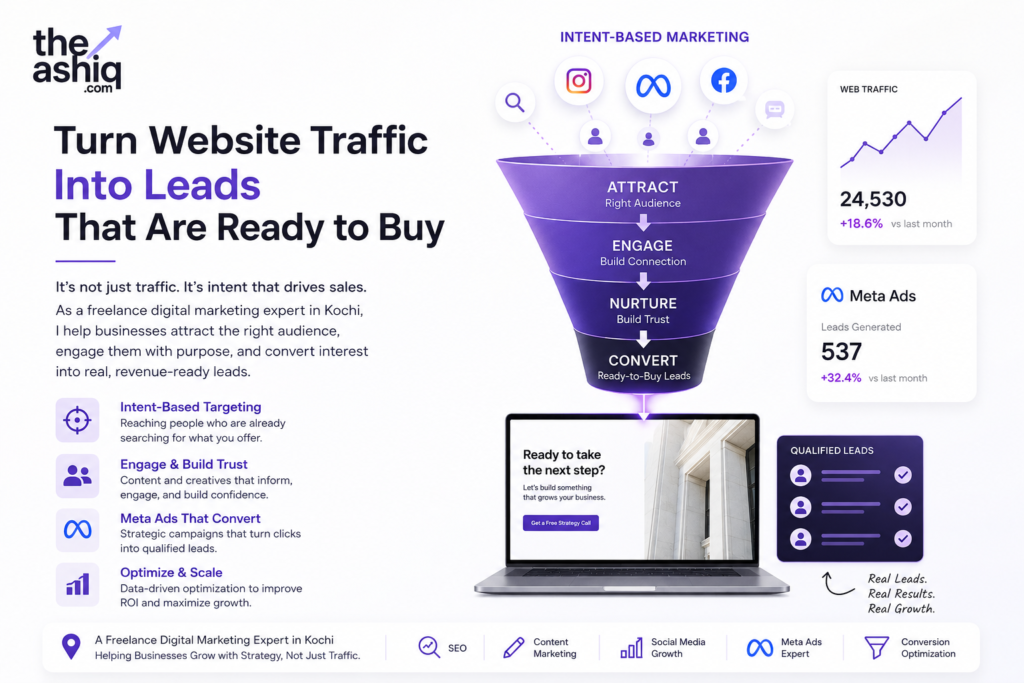
How to Recognize When a Lead Is Truly High Quality
Before jumping into strategies, there is one thing worth knowing about what you are working toward. A High-quality lead tends to meet a majority of the following criteria.
• Have a particular problem your company can solve.
• Are actively seeking out a solution rather than browsing around.
• Are like the rest of your high value clients.
• Have actually taken some concrete action like booking a consultation, filling out a form, requesting a quote.
• Have the authority and money to make a buying decision If the “lead” is lacking in several of these criteria, it is nothing but traffic with a lead label
Real Consequences of Putting Quantity Over Quality
Companies that only care about lead volume inevitably face the following issues again and again.
Their sales team gets tired of leads that go nowhere. Any hour wasted chasing unqualified contacts equals an hour lost closing actual business.
Marketing money gets wasted. Wide but untargeted campaigns spend dollars on people who won’t become customers anyway.
Customer retention rates suffer. Unsuitable customers leave quicker and almost never refer others.
Company reputation gets hurt. Inconsistent marketing efforts attract unsuitable people and frustrate them.
But turn things around make fit the priority over quantity and those issues solve themselves.
Seven Channels You Should Be Using (Plus How to Do It Right)
1. SEO: Your Compounder
It takes time for search engine optimization to pay off initially, but once it does, the results are quick to compound. The page that ranks will attract qualified traffic indefinitely without further spending.
Areas to focus on:
• Long-tail and intent-specific keywords (“emergency plumber in [city]” beats “plumbing”)
• Page loading speed (especially mobile).
• Correct title tags and meta description.
• Complete Google Business Profile optimization.
2. Content That Educates, Not Promotes
Those companies that succeed with their content don’t promote products; they educate. Through how-to articles, FAQs, comparisons, and customer case studies, the brand establishes its authority even before the first conversation with a representative happens.
Content types to test:
• Detailed guides and tutorials
• Case studies with actual results shown
• Small video explainers
• Comparison pages
• Downloadable checklists
3. Social Media as a Tool for Building Trust
Instead of using social media as a megaphone, try to see it as a conversation platform where you communicate with people. Publish proof (results, testimonials, behind-the-scenes materials), respond to comments, and post regularly.
• LinkedIn usually works the best in B2B and professional services.
• Instagram and Facebook do great for consumer and local businesses.
• Replies should be made quickly — delayed replies hurt trust.
4. Paid Search to Close Deals Faster
Where SEO needs time, paid ads bring you results instantly. With them, you can appear to people who are actively looking for what you offer.
Make campaigns focused:
• Match ad copy with a landing page, not the homepage
• Take weekly, not monthly, measurements of cost per lead
• Shut down poor-performing ad groups immediately
5. Landing Pages That Have One Job to Do
The job of the homepage is to do everything. The job of the landing page is to convert. This means no navigation, competing offers or anything that doesn’t serve three elements: the headline, the benefit, and the call to action.
A typical conversion-focused landing page features:
• Only one clear headline solving visitor’s problem
• Benefit-oriented copy (not feature oriented)
• Testimonials or trust badges in close proximity to CTA
• Short form without many friction points
• One clear call to action
6. Emails as Follow-Ups
Not all visitors will be willing to make a purchase from your business at first sight. This is why emails are a must-have tool for staying relevant until they become ready to buy from you — without turning into one of those annoying businesses that send email just for the sake of sending one.
Integrate value in-between offers: tips, valuable information, interesting case studies win over constant discounts.
7. Metrics for Tracking Performance
Without knowing whether your strategy works or not, all efforts listed above are in vain. Make a dashboard and review it every week, not once a quarter.
Metrics you should track:
| Organic traffic | SEO efforts progress |
| Conversion rate | Visitors’ actions |
| Cost-per-lead (CPL) | Efficiency of paid channels |
| Lead quality score | Right visitors are converting |
| Customer acquisition cost (CAC) | Customer cost calculation |
| Customer lifetime value (CLV) | Cost-efficiency of customers |
Five Mistakes Killing Your Leads Slowly
1. Marketing to “everyone” It does not make sense to create a marketing message for everyone.
2. Ignoring SEO You will be limited only to pay traffic after this decision.
3. Confusing CTA Visitors will not know what to do next, therefore, will not do anything.
4. Poor mobile experience Mobile traffic rules – if loading of your website takes much time, visitors will leave without any conversion.
5. Late follow-up Reaction time to the lead is a great predictor of conversion
FAQs
. How quickly can I have my leads up and running?
Paid Search will give you the quick result, while SEO and Content will need some time to produce results
. Do I need to use all seven channels in order to produce leads for my business?
Not necessarily – it would be better to try one or two channels first and then proceed.
. How can I determine if my leads are “high quality”?
Monitor conversion rate and CAC by CLV. When leads convert well but don’t hang around or spend money, it’s time to tweak the targeting, not the amount
Key Takeaway
Lead generation doesn’t work on a number’s basis; it works on a fit basis. The companies that are going to be successful are the ones that are going to be specific on their target market, reach the right people, through the right channel at the right time, and measure persistently. Take one channel, test it and add the next channel to the mix.